Change Management in Management Consulting Projects: A Strategic Framework for Sustainable Transformation
In the modern corporate landscape, management consulting initiatives often fail not because of flawed strategies or suboptimal operational designs, but due to human and organizational resistance. Strategic recommendations, enterprise resource planning (ERP) deployments, and governance realignments remain theoretical blueprints unless accompanied by a structured, evidence-based change management framework. Within the discipline of organizational architecture, change management in management consulting projects serves as the critical bridge connecting strategic intent with sustainable operational execution.
This comprehensive guide explores the operational mechanics, leadership dynamics, and analytical frameworks required by senior executives, transformation directors, and management consultants to navigate organizational complexity and secure high user adoption rates across enterprise-scale initiatives.
1. What is Change Management and Why is it Critical in Management Consulting Projects?
Organizational Change Management (OCM) in management consulting is the systematic alignment of structure, culture, process, and human capability to transition an enterprise from a current state to a desired future state. While management consultants traditionally focus on strategy formulation, organizational redesign, or process optimization, change management addresses the psychological, behavioral, and cultural friction that accompanies structural realignments.
Consulting engagements inherently introduce disruption. Whether restructuring corporate governance, introducing digital platforms, or optimizing supply chain architecture, the intervention alters established power dynamics, operational routines, and psychological contracts between employees and the enterprise. Without integrated change management, organizations suffer from severe operational friction:
- Strategic Dilution: High-level consulting blueprints are partially implemented or outright ignored by operational teams.
- Productivity Loss: Prolonged uncertainty leads to employee disengagement, turnover of key talent, and operational downtime.
- Resistance Costs: Active and passive organizational resistance delays project milestones, increasing implementation budgets and diminishing return on investment (ROI).
Integrating change management into consulting projects ensures that organizational architecture is treated as a dynamic, human-centric system rather than a static organizational chart. It converts strategic deliverables into adopted, institutionalized business practices.
2. Comparative Analysis of Leading Change Management Frameworks
To successfully execute change within complex enterprise environments, consultants and executive sponsors rely on established analytical frameworks. Selecting the appropriate framework depends on the scale of intervention, organizational maturity, and the specific dynamics of the project cluster.
Kotter’s 8-Step Process for Leading Change
Developed by John Kotter, this macro-level leadership framework focuses on top-down alignment and enterprise-wide momentum. It is particularly effective for major corporate restructurings and strategic re-orientations.
- Creating Urgency & Coalition: Establishing a compelling narrative around the necessity of change and building a powerful guiding coalition.
- Vision & Strategy: Formulating a clear strategic transformation vision and communicating it aggressively across all communication channels.
- Empowerment & Execution: Removing structural barriers, generating short-term wins, and consolidating gains to produce deep cultural transformation.
Prosci’s ADKAR Model
While Kotter operates at the macro-organizational level, the ADKAR model (Awareness, Desire, Knowledge, Ability, Reinforcement) focuses on the individual psychological transition. It is the premier framework for operational change management, particularly in change management in software implementation and ERP deployments. This also connects to change management in ERP and HRM software deployment in practice.
- Awareness: Understanding the business rationale and urgency behind the transformation.
- Desire: Cultivating individual willingness to support and actively participate in the change initiative.
- Knowledge: Providing operational and conceptual training on new processes, tools, and roles.
- Ability: Facilitating hands-on capability building to ensure proficiency in execution.
- Reinforcement: Establishing incentives, governance loops, and metrics to prevent reversion to legacy behaviors.
McKinsey Frameworks: The 7-S Model and the Influence Model
Management consulting practice frequently leverages McKinsey’s proprietary methodologies to evaluate structural and behavioral readiness. The McKinsey 7S Model in change management evaluates the alignment between hard elements (Strategy, Structure, Systems) and soft elements (Shared Values, Style, Staff, Skills). Complementing this, the McKinsey Influence Model identifies four key levers for driving mindshift and behavioral change: Fostering Understanding, Reinforcing Systems, Capability Building, and Role Modeling.
3. The Role of Management Consultants in Navigating Organizational Resistance
Organizational resistance is not merely an emotional reaction; it is an organic protective mechanism triggered by perceived loss of control, autonomy, or status. Management consultants play a pivotal role as objective, neutral change agents equipped to diagnose and neutralize resistance structures.
Differentiating Active vs. Passive Resistance
Consultants must distinguish between active resistance (open opposition, refusal to adopt standard operating procedures, public pushback) and passive resistance (superficial compliance, deliberate delays, withholding critical knowledge). While active resistance is easily identified and addressed through leadership alignment, passive resistance is far more insidious and frequently sabotages long-term project delivery.
Stakeholder Mapping and Influence Architecture
To navigate resistance, management consultants construct sophisticated stakeholder influence maps. By categorizing key stakeholders based on their degree of influence and level of buy-in, consultants design targeted intervention plans:
- Key Champions: Leverage as peer influencers and operational change leaders within departments.
- Skeptics with High Influence: Require direct, one-on-one engagement, objective data presentation, and tailored incentive structures.
- Fence-Sitters: Mobilize through early wins, transparent communication, and structured capability building.
As neutral third parties, consultants insulate internal management from political friction, enabling hard governance decisions while maintaining collaborative relationships across working teams.
2. Operational Roadmap: Executing Change Management in Transformation Projects
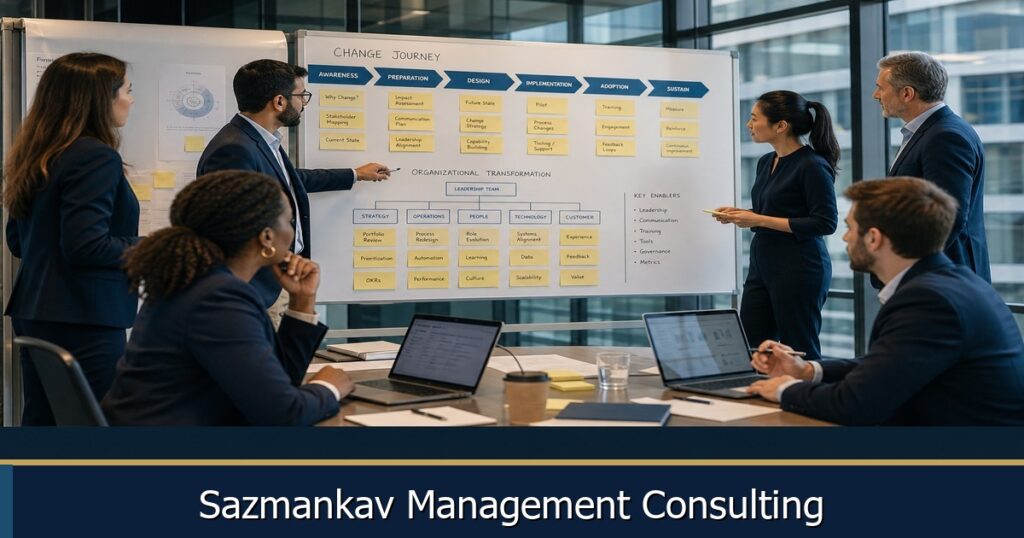
A rigorous change management methodology unfolds concurrently with the primary management consulting lifecycle. The operational roadmap spans four strategic phases:
Phase 1: Diagnostic Assessment & Impact Analysis
Before designing change interventions, consultants conduct a comprehensive Change Readiness Assessment. This involves auditing cultural alignment, historical change fatigue, governance clarity, and leadership capabilities. Simultaneously, a Change Impact Analysis measures how specific operational shifts affect distinct employee cohorts across workflow, technology, and governance dimensions.
Phase 2: Strategy Design & Communication Architecture
During this phase, consultants define the targeted change management strategy. This includes formulating a tailored communication plan that translates high-level executive messaging into role-specific narratives. Transparent, multi-channel communication neutralizes organizational rumors and aligns stakeholders around shared objectives.
Phase 3: Execution, Enablement & User Adoption
Execution requires rolling out structured training, leadership coaching, and change sponsor networks. In technology-driven transformations—such as enterprise resource planning interventions—the focus shifts heavily toward optimizing user adoption rates. Operational documentation, sandbox environments, and real-time support desks are deployed to transition employees smoothly through the learning curve.
Phase 4: Institutionalization & Continuous Optimization
The final phase ensures that implemented changes become permanent elements of organizational culture. Standard operating procedures (SOPs) are updated, performance management systems are aligned with new behavioral expectations, and continuous feedback loops are embedded into corporate governance mechanisms.
5. Key Performance Indicators (KPIs) for Measuring Change Success
To evaluate the efficacy of change management programs, management consultants establish quantitative and qualitative Key Performance Indicators (KPIs). Tracking these metrics provides tangible evidence of operational transition and financial return.
- Speed of Adoption: The rate at which employees transition to new processes, workflows, or technical systems post-deployment.
- Ultimate Utilization Rate: The percentage of target personnel actively engaging with the newly established business architecture.
- Proficiency & Error Rate: The operational accuracy and efficiency demonstrated by staff following training and enablement interventions.
- Stakeholder Sentiment Score: Periodic qualitative metrics derived from change surveys to assess organizational morale, alignment, and perceived leadership transparency.
- Project ROI Realization: The alignment between projected strategic benefits and actual business metrics post-implementation.
6. Regional Dynamics: Change Management in Middle Eastern and Iranian Enterprises
Executing change management within Middle Eastern and Iranian corporate environments requires adapting global theoretical frameworks to distinct cultural, structural, and economic realities. Executives and consultants operating in these regions must account for specific enterprise characteristics:
- High Power Distance & Hierarchical Structures: Enterprise decision-making in regional organizations is frequently centralized. Change initiatives require explicit, highly visible sponsorship from top leadership to gain legitimacy across mid-level management and operational tiers.
- Informal Knowledge Networks: While formal reporting structures govern official tasks, informal social capital and peer networks strongly dictate actual workflow adoption. Consultants must identify informal opinion leaders to drive change from within.
- Resource Scarcity & Environmental Volatility: Economic fluctuations often induce organizational change fatigue. Transformation programs must emphasize resilience, psychological safety, and rapid, demonstrable value creation to sustain stakeholder commitment.
By blending global methodologies—such as the ADKAR model for resistance reduction and McKinsey’s Influence Model—with a nuanced appreciation of local organizational behavior, enterprises achieve sustainable structural modernization.
For a detailed analysis of local implementation strategies and Persian-language managerial guidelines, refer to our comprehensive pillar resource: change-management-management-consulting-projects.
Conclusion: Sustaining Transformation Through Integrated Architecture
Change management is not an optional add-on to strategic consulting; it is the fundamental driver of transformation efficacy. By aligning organizational architecture, structural design, and human capability through structured frameworks, enterprises guarantee that consulting recommendations yield long-term competitive advantage. Whether navigating complex software rollouts or enterprise-wide restructurings, integrating rigorous change management protocols converts strategic ambition into sustainable operational excellence.
References
- Kotter, J. P. (1995). Leading Change: Why Transformation Efforts Fail. Harvard Business Review. hbr.org
- Sirkin, H. L., Keenan, P., & Jackson, A. (2005). The Hard Side of Change Management. Harvard Business Review. hbr.org
- Beer, M., & Nohria, N. (2000). Cracking the Code of Change. Harvard Business Review. hbr.org
- Hiatt, J. (Prosci). The ADKAR Model. Prosci Methodology. prosci.com
- McKinsey & Company. The four building blocks of change. McKinsey Insights.