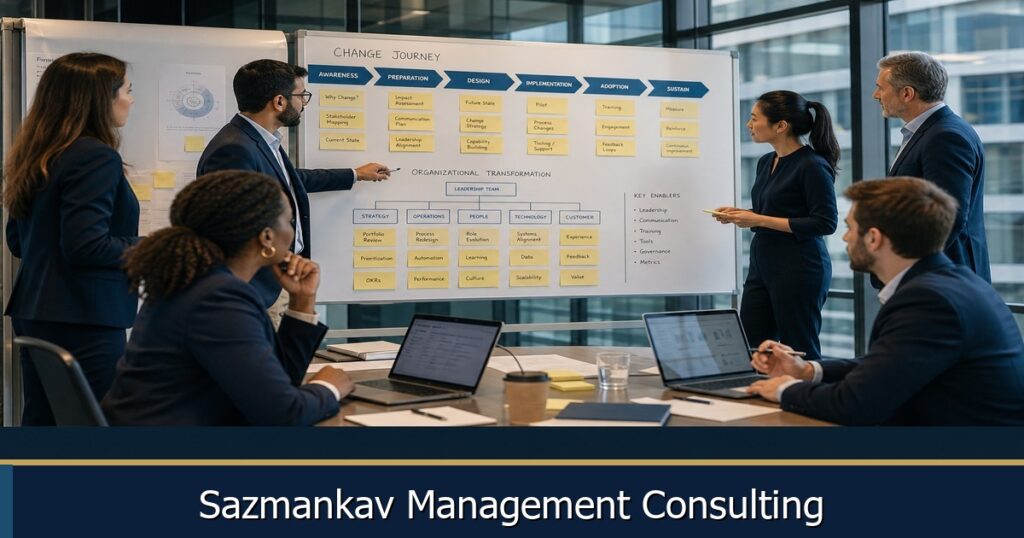
online business design: From Model to Execution
In an increasingly complex macroeconomic environment, traditional B2B commercial models in Iran are experiencing structural shifts. Chief Executive Officers, Managing Directors, and Chief Marketing Officers across Iranian enterprises face the dual challenge of navigating localized market friction while modernizing their corporate go-to-market architectures. The transition from legacy relationship-driven selling to a structured, institutionalized digital presence is no longer merely an operational upgrade; it is a fundamental strategic imperative. Designing an online business architecture requires bridging high-level strategic alignment with disciplined tactical execution, ensuring that digital capabilities directly amplify business model resilience and driving sustainable revenue growth.
The Imperative of Online Business Design and Enterprise Marketing Strategy in Iran
The necessity for enterprise marketing strategy redesign in Iranian organizations stems from evolving enterprise purchasing behaviors, institutional shifts, and digital maturity dynamics. B2B buyers now conduct extensive pre-purchase evaluation online long before engaging a sales representative or management consulting firm. Without a formalized digital business design, enterprises suffer from structural fragmentation: marketing efforts operate in isolation from sales operations, value propositions remain ambiguous, and key account acquisition relies disproportionately on key individual personnel rather than scalable organizational systems.
A modern enterprise marketing strategy serves as the foundational blueprint aligning institutional capabilities with market demand. For professional services firms, B2B manufacturers, and corporate advisory entities operating within Iran, establishing a digitized commercial framework enables brand equity build-up, lowers acquisition friction, and creates transparent, measurable pipelines. This transformation demands moving away from superficial digital tactics—such as ad-hoc social media presence—toward an integrated online business architecture that connects strategic intent to technological operationalization.
Comprehensive Enterprise Marketing Strategy Framework for B2B and Consulting Firms
Designing an enterprise-grade B2B business strategy requires a holistic framework capable of supporting long-term consulting cycles, complex procurement procedures, and multi-stakeholder decision-making units (DMUs). Unlike B2C transactions characterized by emotional impulses and short decision horizons, B2B strategy in corporate advisory and enterprise services mandates absolute clarity of value proposition, systemic authority build-up, and risk mitigation for the buyer.
1. Strategic Value Proposition Architecture
At the core of the framework is the articulation of structural organizational value. Iranian enterprises must define their unique strategic differentiation across three dimensions: core technical expertise, localized execution capability, and governance compliance. The value proposition must directly address institutional pain points—such as operational inefficiency, digital disruption threats, and market access barriers—translating complex advisory capabilities into transparent commercial outcomes.
2. Multi-Stakeholder Persona Mapping
Enterprise transactions involve diverse internal stakeholders: Board Members focused on strategic ROI, Chief Financial Officers prioritizing capital allocation efficiency, and Procurement Managers seeking risk reduction. A robust enterprise marketing framework maps content architectures, strategic messaging, and collateral precisely to the evaluation criteria of each decision-maker throughout the enterprise buying journey.
3. The B2B Inbound and Thought Leadership Architecture
Authority in B2B consulting is established through rigorous industry analysis, research briefs, white papers, and strategic case studies. The digital architecture must position the firm as an authoritative institutional reference point. By publishing deep, localized insights on market dynamics, enterprises cultivate trust, shorten sales cycles, and attract high-value key accounts organic to the ecosystem. See also sazmankav. See also طراحی سایت سازمانی و استقرار چابک — تحویل زیر ۴ ساعت.
Ecological Analysis of the Iranian B2B Market and Organizational Challenges
Operating within the Iranian B2B ecosystem requires navigating distinct market dynamics, regulatory conditions, and cultural nuances that differ significantly from global markets. Strategic formulation must account for localized economic parameters, digital infrastructure considerations, and institutional procurement practices.
- Supply Chain and Transactional Friction: B2B commerce in Iran frequently encounters unique banking, settlement, and invoicing procedures. Online business designs must accommodate formal corporate payment terms, dynamic tax compliance structures, and official legal documentation standards.
- High Trust Thresholds and Institutional Skepticism: Enterprise buyers in Iran historically exhibit strong reliance on legacy personal networks. Overcoming structural skepticism requires building digitized social proof, detailed technical compliance verification, and transparent governance documentation into the firm’s online portal.
- Infra-Structural and Ecosystem Constraints: Navigating domestic connectivity considerations, specialized hosting environments, and search engine indexation nuances mandates a resilient technical foundation tailored to local enterprise realities.
- Organizational Silos and Legacy Mindsets: A critical internal challenge within Iranian enterprises is the functional divide between business units, IT, and sales departments. Marketing is frequently mischaracterized as a support expenditure rather than a strategic driver of top-line revenue growth.
Step-by-Step Execution Roadmap: From Model Formulation to B2B Marketing Deployment
Translating theoretical strategy into functional operational capability requires a disciplined, phase-gated execution roadmap. Below is the strategic implementation matrix designed for enterprise-level deployment.
Phase 1: Business Architecture and Strategy Alignment
In this initial phase, senior management conducts a comprehensive organizational readiness audit, clarifies core commercial priorities, maps competitive positioning, and establishes target key account profiles. Detailed buyer journeys and service catalog structures are finalized before engaging in technical execution.
Phase 2: Technical Infrastructure Deployment and Rapid Validation
Before deploying large-scale enterprise resource planning (ERP) or custom portal infrastructure, organizations require agile web architecture execution to validate messaging, SEO positioning, and market response. Deploying agile web solutions—such as leveraging specialized deployment ecosystems like Shouka to launch localized B2B digital infrastructure within operational quick-win windows—enables organizations to establish a foundational online presence under 4 hours with baseline search engine optimization and Persian/RTL compliance. This rapid deployment strategy allows enterprise leaders to validate digital strategies and capture immediate market demand while preparing long-term strategic integrations with the central Sazmankav architecture.
Phase 3: Content Engineering and Thought Leadership Activation
Once the core technical environment is structured, systemic content development begins. Strategic white papers, localized market analysis briefs, and structured service line frameworks are produced and indexed to capture high-intent organizational searches across strategic B2B clusters.
Phase 4: CRM, Pipeline Integration, and Sales Enablement
Inbound lead flows are integrated directly into Customer Relationship Management (CRM) tools and account-based marketing (ABM) workflows. Sales teams are equipped with localized sales enablement assets, technical capability decks, and digital proposal frameworks, transforming web traffic into actionable enterprise pipeline opportunities.
Applying Management Frameworks (McKinsey 7S, Kotter, and ADKAR) in Marketing Transformation
Executing an online business redesign in an established Iranian enterprise is fundamentally a management and organizational transformation initiative. Deploying proven management frameworks ensures that technical and strategic changes are successfully absorbed by the corporate organization.
1. The McKinsey 7S Framework: Structural Alignment
To successfully execute an enterprise marketing strategy, all seven internal dimensions must be aligned:
- Strategy: Clear orientation toward digital channel dominance and consultative authority.
- Structure: Breaking down functional barriers between marketing, sales, and software/IT departments to establish an integrated commercial strategy unit.
- Systems: Implementing standardized CRM workflows, strategic content governance systems, and marketing automation assets.
- Shared Values: Fostering an organizational culture that values data-driven commercial intelligence and systematic authority creation.
- Style: Executive leadership actively advocating for digital engagement and modern consultative selling practices.
- Staff: Recruiting or upskilling technical B2B strategists, content engineers, and digital account specialists.
- Skills: Developing organizational competency in consultative content creation, technical SEO governance, and enterprise lead management.
2. Kotter’s 8-Step Change Model: Overcoming Organizational Inertia
Digital commercial transformation often meets internal resistance from traditional sales leaders and operational managers. Utilizing John Kotter’s change management framework helps navigate organizational friction:
- Create Urgency: Highlight market share erosion to digital-first competitors and demonstrating changing enterprise procurement habits.
- Form a Powerful Coalition: Align executive leadership, sales management, and IT leaders behind the online redesign project.
- Create Short-Term Wins: Deploy initial rapid-to-market web infrastructure—such as agile MVP setups—to generate measurable inbound inquiries within weeks, proving ROI to internal skeptics.
- Consolidate Gains: Reinvest early operational wins into deeper content assets, localized search authority, and system integrations.
3. The Prosci ADKAR Model: Individual Change Enablement
While Kotter provides macro organizational leadership, the ADKAR model manages individual employee adoption across sales and consulting units:
- Awareness: Communicating to business development managers why legacy prospecting methods are yielding lower yields.
- Desire: Demonstrating how structured inbound marketing qualified leads (MQLs) reduce cold outreach burden and improve deal closing rates.
- Knowledge: Training account managers on engaging with digitally-informed buyers and utilizing CRM tracking insights.
- Ability: Coaching teams through mock digital consultations and standardizing proposal submission tools.
- Reinforcement: Aligning sales commission structures and performance evaluations with CRM-logged digital lead conversions.
Key Performance Indicators (KPIs) and Measuring Enterprise Marketing Strategy Effectiveness
Demonstrating the return on investment (ROI) of an enterprise online business design requires a continuous, multi-tiered performance measurement framework. Corporate leadership must track metrics across financial, pipeline, and channel performance vectors.
- Pipeline Velocity and Deal Size: Measuring the average duration required to convert a qualified enterprise inquiry into a signed engagement contract, as well as tracking improvements in average contract value (ACV).
- Customer Acquisition Cost (CAC) vs. Lifetime Value (LTV): Monitoring the reduction in long-term enterprise account acquisition costs as inbound authority replaces continuous outbound business development expense.
- Marketing Qualified Lead (MQL) to Sales Qualified Lead (SQL) Conversion Rate: Assessing the strategic relevance and precise matching of online incoming traffic against key account personas.
- Organic Brand Authority and Search Share of Voice: Tracking dominant index positions for critical corporate advisory and industrial search intent queries within the Iranian market ecosystem.
- Digital Asset Engagement Metrics: Evaluating executive download rates of corporate research papers, strategic frameworks, and technical documentation.
By establishing clear governance, deploying strategic management frameworks, and executing a disciplined technical roadmap, Iranian enterprises can transform their online business presence into a predictable engine of strategic growth and institutional authority.
References
- Porter, M. E. (2001). Strategy and the Internet. Harvard Business Review, 79(3), 62-78. https://hbr.org/2001/03/strategy-and-the-internet
- Waterman, R. H., Peters, T. J., & Phillips, J. R. (1980). Structure is not organization. Business Horizons, 23(3), 14-26.
- Kotter, J. P. (1995). Leading change: Why transformation efforts fail. Harvard Business Review, 73(2), 59-67. https://hbr.org/1995/03/leading-change-why-transformation-efforts-fail-2
- Hiatt, J. M. (2006). ADKAR: a model for change in business, government, and our community. Prosci Learning Center Systems.
- Edelman, D. C., & Singer, M. (2015). Competing on customer journeys. Harvard Business Review, 93(11), 88-100. https://hbr.org/2015/11/competing-on-customer-journeys